All about the character of Anxiety in Inside Out 2, what the movie teaches about anxiety, and how it helped me better understand my own anxiety and mental health:

I walked out of the theater for Inside Out 2 with the feeling that I’d just seen one of the most impactful movies of my life.
It’s a fun, brightly colored, animated children’s movie. There are puns like a “Sar-chasm,” silly video game references, and Riley’s obsession with a band called “Glow Up.” Yet behind all of that is a film that shook me to my core.
I have struggled with anxiety for my entire life. I’ve done therapy, taken medication, read lots of books, gotten workbooks and art therapy books, and everything you could think of to try and ease my anxiety and understand it better. But it was this Pixar movie that has helped more than almost anything else.
I felt seen in that moment, but it was more than that too. Anxiety is a twisted mess of emotions, feelings, and thoughts that often feel overwhelming and undefinable. Yet here, on a movie screen, in an animated form, was a visual representation of what I feel and go through.
I saw myself on screen, but I also understood myself better in that moment than I ever have before in my 36 years.
I’ve been taking notes and thinking about writing this blog post for over a month – since I first saw the character of Anxiety in Inside Out 2. Perhaps not surprisingly, I’ve felt some anxiety about actually sitting down to put all of this into words. There’s certainly some anxiety about sharing my words with the world, too.
Just like Soul really changed my life back in 2020, this feels like another pivotal moment. Is that too dramatic when we’re talking about animated movies? Maybe, but I don’t think so.
I feel compelled to write this post because writing has helped my anxiety in the past. Being able to (at least attempt to) put into words how I feel and how I view my feelings is important. But also because I truly believe the more that we can talk about mental health topics, the better it is for everyone.
Understanding Anxiety
“He keeps Riley safe from things she can see. My job is to keep her safe from things she can’t see.”
I spent the first 20 years of my life thinking I was scared of everything. Eventually, I got to a wonderful therapist who helped me with a diagnosis of anxiety and depression.
Anxiety isn’t just fear. As she explains it in the quote above, fear “keeps Riley safe from things she can see. My job is to keep her safe from things she can’t see.” No one had ever said anything like that to me when I was Riley’s age. So I thought I was just a big scaredy cat. The one who would never be sorted in Gryffindor.
So then – what exactly is anxiety? It’s important to realize that there are many kinds of anxiety, and it can present itself differently for different people (or different situations).
And everyone experiences anxiety. Having some anxiety is normal. We get anxious before big tests, presentations, traveling, or major life events.
That doesn’t mean everyone has an anxiety disorder. The way they do the character of Anxiety in Inside Out 2 is a great way to understand this – we all have Anxiety as one of those emotions up in headquarters. But people with an anxiety disorder let Anxiety take the controls more often than not, and that’s when it becomes a problem (arguably any one emotion taking the controls all the time is a problem, even Joy).
Anxiety isn’t a bad thing in and of itself (more on that later), but too much of it is not healthy. My Anxiety tries to come up with explanations for everything and consider every option. When something happens it’s like there is a map in my brain with a million different paths. And I try to hypothetically follow all of them, as each one of those paths also branches off into additional paths.
So when Anxiety says, “My job is to keep her safe from things she can’t see,” it means that she deals with uncertainty. She tries to make sense of a world that doesn’t make sense and isn’t always rational – which is a pretty great representation of exactly what anxiety is.
Anxiety & the Future
“Joy, the next three days could determine the next four years of our lives.”
Anxiety prepares for the future. In moderation, this is a good thing. In excess and with overthinking, we can see how harmful it can be. It drives Riley to do things she wouldn’t normally do to try and combat every possible negative scenario.
And this can be useful. As our 5 original emotions encounter obstacles, Fear mutters several times, “anxiety would have thought of that.” And he’s right – those of us who live with that anxiety know how useful it is. I’ve often wondered how other people could possibly get into certain situations – didn’t they think of that? But then I realize that not everyone has the anxiety that I do.
Anxiety shows up at headquarters with things to worry about that aren’t even on Joy’s radar. And most of them are legitimate things – it would be normal for a teenager to worry about having to make new friends at school. Joy wants to live in the moment and focus on Riley’s current friendships, while Anxiety wants to plan for the future and the friendships she might be able to develop.
But it’s easy for Anxiety to spiral out of control with her “what ifs”. Again, they start somewhat reasonably, but then get more unreasonable and unlikely. Especially with an active imagination, it’s easy to keep going forever with catastrophizing.
We can never truly know what is going to happen in the future. We can try to prepare all we like, and we can imagine lots of potential scenarios. But sometimes life throws something at you that you couldn’t even imagine. For those of us with anxiety, that can be the scariest thing in the world to accept. But working on accepting that fact is also one of the most freeing things.
Anxiety & Perfectionism
“No, you’re totally right. That’s not gonna haunt us for the rest of our lives at all.”
It’s not surprising that anxiety is closely tied to perfectionism. We see that in the character of Anxiety in Inside Out 2 – she shows up prepared, knowing how things work at headquarters, with lots of plans.
And Anxiety truly wants Riley to be her best self. That is the perfectionism coming into play, because she wants Riley to be perfect. She wants to protect her by imagining every possible thing that could happen which would hurt Riley, so she can have a plan to prevent it from happening.
But we can see that perfectionism fueling Riley’s anxiety, and it’s very relatable for many of us. Riley is so hard on herself when she makes a mistake or fails at something. She has incredibly high standards for herself and is quite self-critical.
It’s another slippery slope, and it comes as a result of Riley not accepting her true sense of self yet. She hasn’t accepted herself with her flaws, so she beats herself up over those negative emotions.
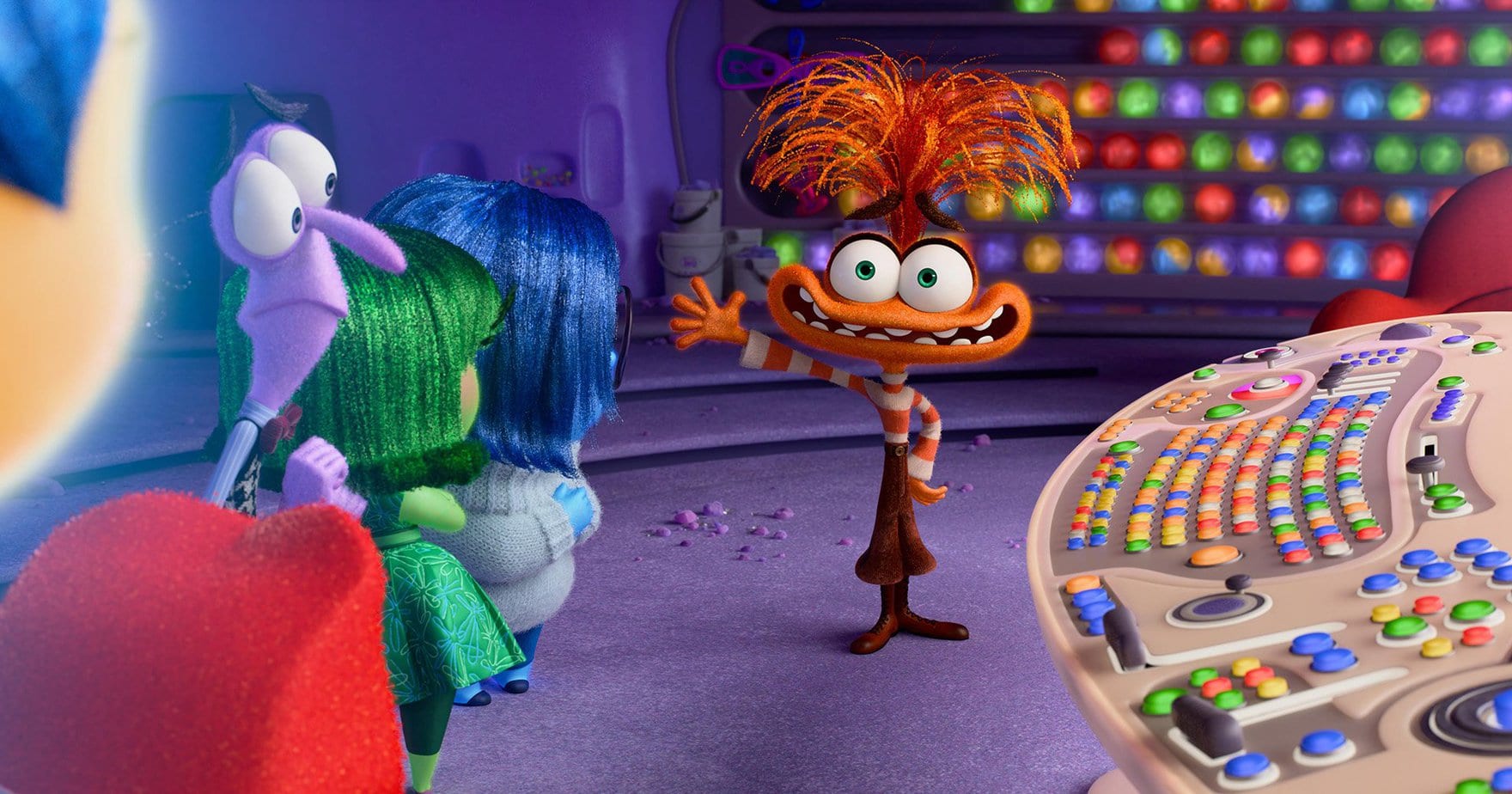
Anxiety’s effect on the other emotions
“Riley’s life is more complex now. It requires more sophisticated emotions than all of you. You just aren’t what she needs anymore, Joy.”
Anxiety shows up with the same goal as the rest of the emotions – she wants what is best for Riley. She wants to protect her and she wants her to be happy and succeed.
But of course, she goes too far, by literally “bottling up” the other emotions. And that’s the tricky part about anxiety. It’s not a bad thing in and of itself. It can be quite useful. But it can take over really easily, and shut out everything else.
In fact, Anxiety meshes quite well with some of the other emotions when she’s reined in a little bit. Much of what Anxiety does is very beneficial to them. Fear takes a liking to her right away, which is no surprise. Interestingly, her planning for the future and being aware of things seems to help ease his fear a little bit.
Typically (before she gets too far out of control), Anxiety thinks things through. She probably overthinks them – how should I move my arms when I walk? Which band is cool right now? But for Envy, Disgust, and Embarrassment, this can help Riley fit in with the others.
Because worrying about and considering the worst-case scenarios actually can help you avoid some of those worst-case scenarios (or even just not-great scenarios). But balance is key.
It’s only at the end of the film when all of the emotions can come together and create a new sense of self for Riley that she finds balance in her life and her emotions.
Balancing Anxiety & Joy
“Maybe when you grow up you feel less joy.”
Of course, it’s Joy who struggles the most when Anxiety shows up. This feels accurate too: it’s really hard to have space for both joy and anxiety in our minds sometimes. When Anxiety takes over, Joy (and the other emotions) are literally kicked out. It feels like this happens in my mind sometimes when my anxiety is too strong.
And Joy has been doing a better job at letting others take a turn at the controls! After all, she learned her lesson in the first movie and makes space for Sadness. But Anxiety feels like a different beast entirely because Joy doesn’t have any experience with her, and she doesn’t understand her.
But they can learn from each other. And at the end of the movie, we see a glimpse of just that. It won’t be easy – that balance is one of the biggest struggles of my life. But it is possible.

Anxiety & Panic attacks
“I was just trying to protect her.”
Towards the end of the film, Riley experiences a panic attack. In my opinion, the portrayal of Riley’s panic attack was basically perfect. It put up on the screen in a visual way how it feels inside my mind when that happens.
First Anxiety is running around wildly, trying to do everything she possibly can to save the situation. She’s literally a blur, taking every action she can think of and pressing every button. No one can say anything to her or reach her.
She doesn’t say it, but I know what Anxiety’s thinking in her panic is this: “I’m in control. I can fix this! I can do something!”
But then she freezes. It all becomes too much. She’s still in a panic, but she’s also not doing anything. I’ve never seen a better way to portray my mental state during a panic attack.
Ultimately, once Joy steps in, Anxiety realizes she’s not in control at all. In fact, she’s totally out of control. So how do they ease the panic attack?
It starts with working on a new sense of self for Riley. It’s when Joy and Anxiety can co-exist and allow Riley to have both positive and negative thoughts about herself. She can be happy in the moment but still worried about things in the future. My panic attacks often happen when things feel outside of my control, or when I’m experiencing feelings I think I “shouldn’t” be happening.
All of the emotions embrace this new sense of self, which was very symbolic for me in multiple ways. It shows the important role all of our emotions play in making up who we are. It also hit home for me because when I go through my panic attacks, my loved ones sometimes feel lost or don’t know what to do.
I can be crying, hyperventilating, or curled up in a ball. But at least for me, one thing that always helps is just a really good hug. Without questions or statements to try and make things better. Just being there to hold me, so I can feel safe, makes a huge difference.

Anxiety and Your Sense of Self
“I’m not good enough.”
One of the new concepts in Inside Out 2 is the “Sense of Self.” These are memories that are “planted” and take root to help create Riley’s purpose and beliefs. “I am kind.” “I am good.” The Sense of Self is how we define ourselves.
And it is always growing and changing. New memories can be planted as we gain more experiences. Like she does with so many things, Anxiety takes that idea and runs with it. Her goal is to give Riley a new, better Sense of Self.
But ultimately, all of those anxiety-driven memories leave her with this: “I’m not good enough.”
That might be the first moment I cried in this movie. Because it’s a phrase I’ve heard in my own head over and over again. It’s a thought I try to overcome almost every single day. It shows up in almost everything I do.
And this is what happens when you focus only on trying to stop bad things from happening. For Riley, it starts as “If I make the hockey team I’ll have friends at my new school.” But it quickly devolves into something like “If I make the hockey team I won’t be miserable and alone.”
For me, it could look like “If I run 3-4 times a week my running will improve.” It’s easy for that to become “If I run 3-4 times a week I won’t suck at running anymore” or “If I run 3-4 times a week maybe I won’t hate myself as much because I’ll actually be good at something.”
That’s how the Sense of Self becomes negative, exhausting, and overwhelming. And when you inevitably don’t achieve the (somewhat arbitrary) things that tell you how to define your worth, you end up with “I’m not good enough.”
When Anxiety changes who you are
“OK, Riley. Let’s change everything about you.”
One of the more difficult scenes to watch in this movie is when Riley sneaks into her coach’s office to look at her notebook on the players. We know Riley is a good kid. We know this isn’t the sort of thing she’d normally do, but she’s driven to do it regardless.
This one hit pretty hard for me because it shows some of the ways that anxiety can manifest itself in your actions. One of the things I’ve found most difficult to explain to others about my anxiety is the overwhelming sense of pressure and the need to do SOMETHING.
When I’m in a panic attack, or my anxiety is really bad, just sitting and waiting for whatever is going to happen doesn’t feel like an option. I literally feel like my heart will beat out of my chest, or I will never fall asleep and then I’ll be miserable the next day, or my brain will never stop and I’ll overthink everything so much I won’t know what’s true anymore.
I have to fix it, I need to do something, what can I do?
That’s when I do things I’m not always proud of. Maybe it’s a fight with a friend and I know I should just let it simmer and talk about it when we’re more level-headed, but I need to do something now before my anxiety destroys me. So I send a million texts and most likely make everything worse.
I know that’s not the right choice, just like Riley knows it’s not the right choice to break into the office.
But as someone with strong anxiety, choosing inaction and waiting over action feels like one of the hardest things in the world. And that’s when it feels like you aren’t being true to who you are or who you want to be.
Accepting who you are – your REAL sense of self
“I’ll just tell Anxiety not to worry so much anymore. And then she’ll say ‘Wow, Joy! I didn’t think of that, thank you!’”
Ultimately Riley needs to get a new Sense of Self. “I’m not good enough” is certainly not what we want, but just “I’m a good person” isn’t enough either.
The lesson here could have easily been that Riley needs her own “original” sense of self back, and that certain emotions are a better foundation for who we are than others. “Good will overcome,” etc. But that’s not what happens here.
Instead, it’s about accepting who you are. The good and the bad. You can be a good friend and a bad friend sometimes. You can be a generally honest person but lie once in a while. Feeling ashamed or shutting out those other memories or feelings will not give you an accurate representation of yourself.
That’s what human beings are. We are a balance of good experiences and bad ones, and they all make us part of who we are. We are not perfect. We are messy beings, and our sense of self is similarly messy. A person’s sense of self shouldn’t just be “I am kind” and “I am good” by itself. But it also can’t be just “I’m not good enough.”
Like all of the emotions, Anxiety is trying to help Riley and tell her something. We need to listen to all of our emotions, including anxiety.
It feels a little easier to “accept” Sadness, or Anger. We learned that in the first movie, and we could say hey, it’s okay to feel sad or angry sometimes. But accepting Anxiety seems like a more difficult task.

Accepting Anxiety
“Do you know how hard it is to stay positive all the time?”
One of the most important things I learned from Inside Out 2 was the concept of accepting my anxiety rather than fighting it. It needs to be managed, of course, but I don’t need to erase it completely.
Because I can’t. But trying to accept that it’s there is the first step to not being so hard on myself. I can recognize the positives that anxiety brings me, and I can try to talk it down a little when it wants to spiral out of control.
After seeing Anxiety in Inside Out 2, my husband and I talked about it. He is not someone who deals with anxiety regularly while I am. I told him how accurate it felt to see all the projections Anxiety was creating, and how it can completely take over my mind. I told him I have to fight every single day to choose not to create those scenarios – or at least to not listen to them and let them take me over.
He said he’d never thought about it as “fighting” before. And I’m hesitant to use that word because I think the important lesson I’ve learned is not to treat Anxiety as a villain. I’m not fighting Anxiety itself, but I am fighting off some of those little negative thoughts she keeps planting. I’ve personally called them thought demons myself in the past.
The fact that there can be a place for Anxiety at the console, and that’s totally okay, actually eases some of my anxiety. Fighting anxiety or eliminating it felt like a losing battle because it is so much a part of me. Getting rid of it felt impossible. Now I don’t have to feel like I’m trying to accomplish the impossible every day. I’m trying to just find balance, and that seems much more within reach.
Because mental health isn’t just feeling happy all the time. It’s about managing our feelings and allowing them in to listen to the messages they are trying to give us. Being able to understand and recognize all of our feelings, including anxiety, might help all of us cope just a little bit better.
I can let Anxiety in and accept it as part of me, but I cannot let it solely define me.
The positives of Anxiety
“Anxiety would have a plan for that.”
One thing that is key in getting to a place where you can accept Anxiety is recognizing the positives of it. Our emotions all serve a purpose, and anxiety can be very beneficial. We just have to be careful of healthy vs. unhealthy anxiety.
For Riley, getting up early to practice hockey is a good thing. Not sleeping and overworking her body with too much practice is not healthy. Anxiety reminding you that you need to study for a Spanish test is helpful. Staying awake worrying all night about the test is not.
Anxiety can help warn you about potential dangers or come up with some tools to help prepare you for situations. If we didn’t worry about anything ever, we probably wouldn’t do anything productive, or succeed at school, or in the workplace.
And anxiety is a form of caring. And it’s important to care about things – our loved ones, the work we do, the world in general. It’s motivated by a positive desire.
It can also show you what is and isn’t working in your life. If you feel overly anxious about something, maybe there’s an explanation for why that is.
I’ve been described as patient or understanding, but it’s because of my anxiety that I am able to train my brain to think of so many different possible outcomes or explanations for things. If I ask a friend if they want to hang out and they say no, I imagine 2 dozen reasons why. That’s my anxiety hard at work.
What I’ve been working on is not to jump to the worst of those 2 dozen explanations. Anxiety tends to present the really bad ones first, and we accept them without considering the other options.
What’s been helpful for me is to say, “Yes, brain, one potential reason is that my friend hates me now. But what other reasons could there be? Maybe she is mad about something and isn’t sure how to talk about it yet. Maybe she’s not feeling well. Maybe she’s just really burnt-out from work and needs to just stay home. Maybe she’s planning me a surprise party and is prepping for that.”
Just like Joy started drawing projections of happy outcomes for Riley, we need to draw those happy ones too (alongside the others). Then I can look at them and say, “All of these are possible. But which are actually likely?”
It’s anxiety, in part, that has given me the tools to be able to understand myself and others better. Just like anger, sadness, or any of the emotions, it’s not anxiety itself that can be bad. It’s how we manage and handle having those emotions.

Why this matters
A thought that came into my mind while writing this: You know you have anxiety when you have anxiety about having anxiety. (And if you do, this makes perfect sense).
It sometimes becomes an endless loop of anxiety, and that’s extremely hard to break. Until now, society has tacitly (or blatantly) told us that we shouldn’t feel anxious about things. The perspective that anxiety can be useful and that it’s okay to feel anxious may help break that cycle just a little bit.
And of course, as a movie for kids, getting these conversations started early will be beneficial. The more we try to understand something we may experience (or that others we know will experience), the better off we’ll be.
Finally, I want to conclude with how important it is for people with anxiety disorders to feel seen and understood. And this movie did that for so many.
When I was writing my review of Inside Out 2, one thing that struck me was the difference in reviews between those who have struggled with anxiety and those who don’t. Every reviewer I read who mentioned having anxiety was clearly moved by this movie. The character of Anxiety in Inside Out 2 has touched a lot of people.
I’ll end by letting a few quotes speak for themselves:
“In all the years I’ve had anxiety, since I was roughly Riley’s age, I’ve never seen it depicted so accurately or effectively. Watching the climatic sequence felt like looking in on my own brain, and really understanding, for the first time, how it works when it’s not working well.” – Meg Walter, Deseret News
“There is something to be said for seeing the inner workings of your own brain depicted with such uncanny accuracy on screen for the first time.” – David Opie, Digital Spy
“I saw my own experiences reflected in Riley’s. “Inside Out 2” felt personal to me in a way that was equally cathartic and devastating: It’s a movie that so intimately understands how my anxiety disorder upends my everyday life.” – Maya Phillips, New York Times
Welcome to Headquarters, Anxiety.
Related Posts
Did you relate at all to Anxiety in Inside Out 2? What did you think?

The conclusions you have come to are similar to the ones I did several years ago when my anxiety was ruling my life. I used to fight really hard to decrease the anxiety, to get rid of it, and to not accept that I could coexist with it.
So one day I stopped fighting and pulled up a figurative chair for it to join me at the table. “OK, anxiety. I can;t get rid of you, no matter what I do. So pull up a chair and sit down. I’m the captain of this ship, and I welcome you to stay and appreciate your insight. But I ultimately will make the decisions and I will enjoy my life, even with you right here.”
And it now does not have the power over me that it once did because I can accept it as a part of myself!
What a wonderful way to deal with your anxiety!
THank you so much for sharing your story as well – acceptance is really key, and so difficult sometimes <3
Beautifully written!
Thank you!
<3<3<3
<3
You are so brave to have written this and it is so important for people to read. So many people today lack empathy. They think that everyone is like them: thinks like them, feels like them. Putting this topic out in the open will help others seek help and realize they are not alone. You are also a wonderful example of someone who has made for herself a productive life focused on helping others through your work with children. Your sensitivity and creativity are part of your makeup; I’m sorry that they sometimes get out of control. Thank you so much for sharing this!
Thank you, and I think you’re absolutely right. It can certainly be challenging to understand how others might think or feel when you can’t experience it yourself – that’s why I believe media (books, movies, etc.) are so important like this. The more we can talk about it, and share our experiences, the better.